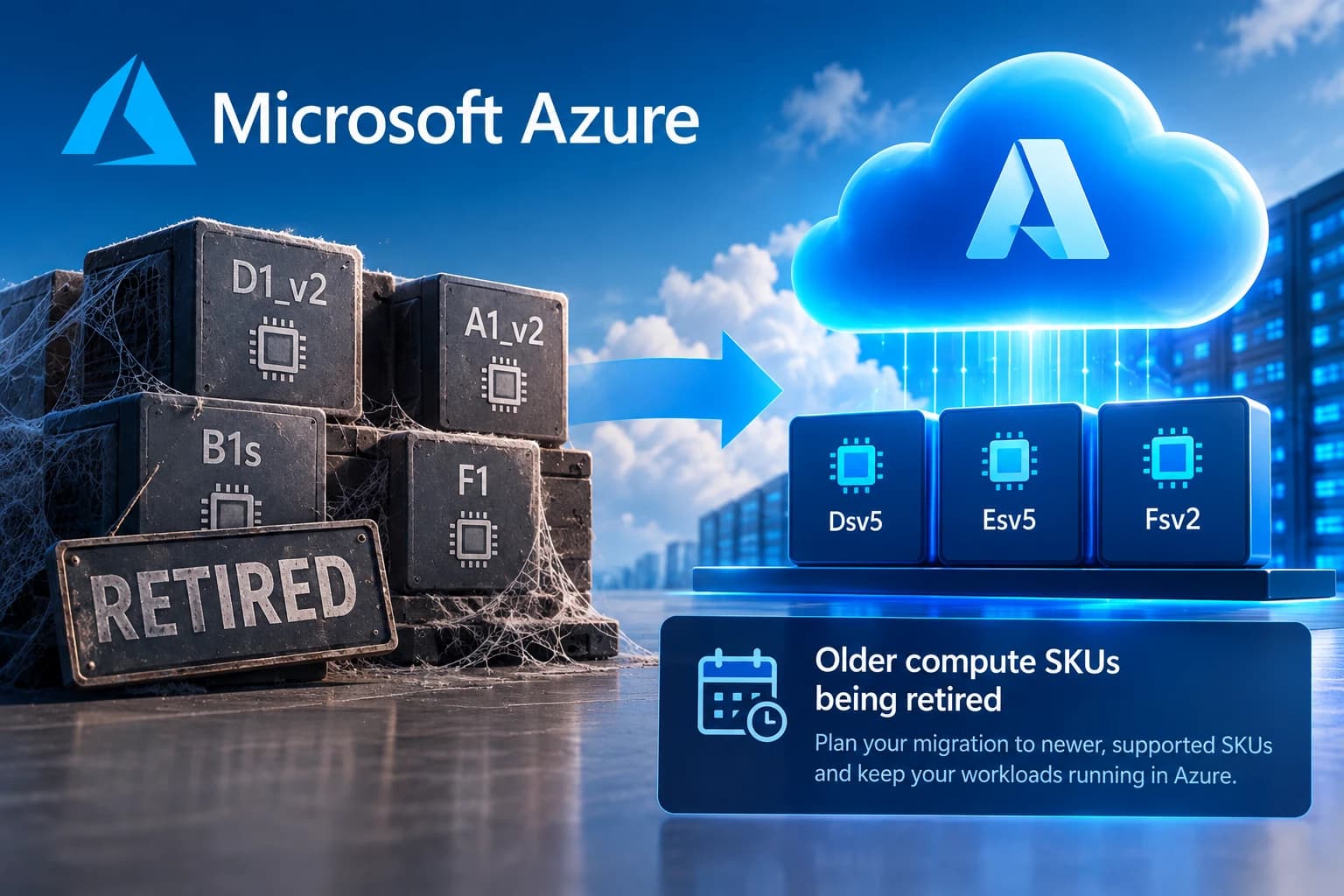
The biggest wave lands in 2028, when the original D, F, G, B and Av2 families go away. The v3 general-purpose and memory-optimized sizes follow on November 15, 2029.
Retirement date | VM series | Category |
|---|
June 30, 2026
Retired | DCsv2 | Confidential computing |
Sept 1, 2026
Retired | DCas_cc_v5, DCads_cc_v5, ECas_cc_v5, ECads_cc_v5 | Confidential computing |
Sept 30, 2026
Scheduled | NVv3, NVv4 | GPU |
March 31, 2027 | Four M192i v2 sizes (Msv2/Mdsv2) | Memory optimized |
May 31, 2027 | NP, HC, HBv2 | FPGA, HPC |
May 1, 2028 | D, Ds, Dv2, Dsv2, Ls | General purpose, storage |
Nov 15, 2028 | Av2/Amv2, B (v1), F, Fs, Fsv2, G, Gs, Lsv2 | General, compute, memory, storage |
Oct 31, 2029 | DCsv3, DCdsv3 | Confidential computing |
Nov 15, 2029 | Dv3, Dsv3, Ev3, Esv3 | General purpose, memory |
On the retirement date, any remaining VMs in a series are deallocated and stop running. They also stop billing and lose SLA and support coverage. The Dv3/Ev3 retirement covers all 32 sizes in those four series but doesn't apply to Azure Government, 21Vianet or other sovereign regions.
The quota freeze is already here
For most teams, the capacity restrictions matter more today than the retirement dates. Starting in July 2026, Microsoft froze growth on the A, B, D, E, F, G and L series listed above, through v3.
New subscriptions can't deploy the affected series.
Existing subscriptions can keep deploying within quota they already have, but requests for more quota won't be approved.
Quota isn't capacity. Microsoft warns that deployments can still fail with allocation errors if a region runs short of the older hardware.
Shared capacity reservations across subscriptions can get stuck, because the consuming subscription may need extra quota it can no longer get.
Microsoft stresses that the freeze is separate from retirement. Dv3 and Ev3 remain fully supported under Azure SLAs until 2029; you just can't grow on them.
What to do now
Microsoft's guidance is to move to v5, v6 or v7 series for anything new. For Dv3 and Dsv3 workloads it points to Dv5, Dv6 or Dv7; for Ev3 and Esv3, to Ev5, Esv6 or Esv7. The v5 path is billed as the smoothest transition, while v6 and v7 bring the newest features.
The reservation side needs attention too. New or renewed one- and three-year reserved instances are no longer sold for the affected v1–v3 series, and expiring ones fall back to pay-as-you-go rates. Reserved instances don't follow you to a new series automatically, so plan an exchange or a move to Azure Savings Plan for Compute. Microsoft allows exchanges until February 1, 2027, after which each eligible reservation gets one final exchange.
A good first step is to inventory which of these series you're running, then start with anything that needs to scale or that relies on shared capacity reservations.
Sources